AI and the Future of Work
The Problem With AI Strategies Built Around Headcount Reduction
A productivity estimate can tell management that some tasks may require less human effort. It cannot tell management what the organization should do with the capacity that becomes available.
A productivity estimate can tell management that some tasks may require less human effort. It cannot tell management what the organization should do with the capacity that becomes available.
Consider an AI business case that estimates a 30 percent productivity gain in a large function. The team identifies tasks that can be automated, converts the expected hours into full-time equivalents, and puts the savings into the financial model. Before anyone has much experience operating the function with the new technology, a future workforce number is already sitting in the plan.
The arithmetic can be clean while the diagnosis is wrong. A productivity estimate can tell management that some tasks may require less human effort. It cannot tell management what the organization should do with the capacity that becomes available. The capacity might eventually be removed. It might be used for activities that were previously too expensive, redirected into revenue-producing activity, applied to problems the organization never had enough people to address, or retained while management learns what AI is actually changing.
That last possibility is getting too little attention. AI is changing quickly, and organizations are trying to redesign jobs and processes while the technology itself is moving underneath them. Yet a surprising amount of workforce planning starts by treating the future headcount as though it can already be known.
Once a number gets into the business case, it starts to take on a life of its own. Finance incorporates the savings. HR plans around the future workforce. Technology teams inherit automation targets. Business units start budgeting against the expected reduction. This is headcount lock-in: an estimate about task productivity is gradually converted into a workforce commitment as different parts of the organization build it into their own plans. The organization has made a decision about future capability before execution has produced enough evidence to support it.
Section One · SENSE
Meta shows why the productivity number can be misleading
Project OT
Meta's Project OT is a useful place to start because the internal numbers show how much the story changes depending on what management chooses to measure. Reuters reported that Project OT, short for Organization Transformation, explored an "AI native" operating model in which agents would take on more tasks and smaller groups of employees would supervise them. Scenario planning considered reductions of as much as 60 percent in some teams through layoffs, redeployment, closing open positions, and performance-related exits. The plan called for two restructuring waves. Reuters reported the details from internal documents and interviews with more than 20 people familiar with the effort.
The internal performance data
The internal performance data show why the productivity story is incomplete. As employees used more AI, code changes to Meta's internal platforms and infrastructure increased about 220 percent year over year. Changes that produced new or improved features for users increased only about 36 percent. Major technical and security incidents rose roughly 40 percent, while the time employees spent dealing with those incidents increased about 70 percent. These were all real measures from the same organization during the same period.
A company looking mainly at code activity could tell itself an extraordinary productivity story. The story looks different once user-facing output, reliability, security problems, and engineering time spent cleaning up those problems are included. More technical activity did not translate into the same increase in useful output, and some operating conditions became worse at the same time.
The reversal
Meta carried out a company-wide reduction of about 10 percent in May 2026 and later canceled planning for the second restructuring wave. Reuters could not determine one cause for that decision and identified several pressures that were building at the same time. The useful part of the case is not an attempt to assign the reversal to one factor. The internal data show how dangerous it can be to take a visible AI productivity measure and treat it as though it answers a broader organizational question.
Section Two
Meta was not an isolated case
Klarna
Klarna pushed the cost logic hard in customer service. In 2024, Reuters reported that its AI assistant was doing tasks equivalent to about 700 full-time customer-service employees and had reduced average resolution time from 11 minutes to two. Over roughly the same period, Klarna's workforce fell from about 5,000 to 3,800, mostly through attrition, and CEO Sebastian Siemiatkowski was openly discussing a much smaller workforce as AI took on more customer-service tasks. The company was presenting the productivity numbers and the shrinking workforce as part of the same AI story.
A year later, Siemiatkowski told Reuters that Klarna had probably "over indexed" on AI-driven cost reduction and had spent the previous six months trying to course correct. The company had started hiring again and was putting more attention on productivity, products, customer experience, and growth. Earlier that year, the SEC had asked Klarna to explain how its AI approach was changing after public comments from Siemiatkowski that some AI service had been lower quality than human service. Klarna's own regulatory record shows that the quality question drew a direct question from the SEC.
The automation numbers were real. So were the cost savings. They were not enough to tell Klarna what good performance looked like. By September 2025, Siemiatkowski was telling Reuters that the company had moved too far toward the cost side and needed to correct the approach. That is the problem with letting the easiest productivity measure become the answer. A system can get faster and cheaper while management is still learning what customers, employees, and the business actually need from it.
Block
Block made the workforce decision even more directly. In February 2026, the company announced that it would reduce its workforce by more than 40 percent, from more than 10,000 people to just under 6,000. Jack Dorsey wrote that AI tools had changed what it meant to build and run a company and that a significantly smaller team could do more and do it better. Reuters described the restructuring as an AI-driven overhaul involving more than 4,000 job cuts.
Block's own filing makes the sequencing hard to miss. The company said the smaller organization would rely more heavily on automation and AI to maintain productivity and operating efficiency. In the same risk disclosure, Block acknowledged that those tools might not perform as expected, that experienced people and institutional knowledge could be lost, that remaining employees could face heavier workloads, and that error rates, innovation, service continuity, and controls could all be affected. Block's Form 10-K says operating successfully with the reduced workforce depends in part on the effectiveness, reliability, and adoption of the AI tools supporting it.
Block is earlier in the story than Meta or Klarna, so the eventual result is still unfolding. The sequence is already clear. More than 40 percent of the workforce was removed while the company's own filing acknowledged that the technology and operating model needed to make the smaller organization function might not deliver the expected result. The headcount decision did not wait for that evidence.
Three versions of the same problem
Meta, Klarna, and Block show three versions of the same problem. Meta had activity measures running well ahead of useful output. Klarna learned that faster and cheaper customer service did not settle the quality and growth questions. Block made a very large workforce decision while its own filing still described the AI-enabled operating model as something that might not deliver the expected benefits.
McKinsey
McKinsey's survey research adds a broader signal, with an important limitation. In 2025, 32 percent of respondents expected AI to reduce their organization's headcount during the following year. In 2026, 14 percent of respondents reported that AI had contributed to an overall workforce reduction during the prior year, while two-thirds reported little or no AI-related change in total employment. Yet 39 percent were again predicting lower headcount for the next year. McKinsey described the previous year's expectations as overstated.
These were not longitudinal surveys tracking the same organizations over time, so the figures should not be read as a direct test of whether individual forecasts proved right or wrong. They do show that expectations of AI-driven workforce reduction remained much higher than reported experience even after the prior expectations were described as overstated. That gap should raise the bar for turning another forecast into a staffing commitment.
Why the pattern persists
Why does this pattern persist in sophisticated organizations? Part of the answer is timing. A planned headcount reduction creates a benefit that is immediate, legible, and easy to put into a financial model. Reuters reported that Block's shares surged after its reduction announcement. That reaction does not tell us why Block made the decision, but it does show how quickly the savings story can become visible to outside stakeholders. The costs of a wrong staffing assumption usually arrive later and are harder to trace back to the original decision. Rework, lost expertise, heavier workloads, slower decisions, service problems, and weakened controls may surface across different budgets and reporting lines. By then, the savings have already been counted and the workforce plan may be embedded in multiple commitments. That timing asymmetry is one reason headcount lock-in can persist even when new operating evidence points in another direction.
Section Three · EVOLVE
Some companies are leaving the answer open long enough to learn
Walmart
Walmart provides a different case because it is already using AI across a very large workforce and has still been reluctant to pretend that it knows the final employment answer. In its 2026 Jobs Spotlight Report, Walmart said that while AI is often framed as a job eliminator, "it seems too early to make predictions on the impact." The company has about 2.1 million associates globally, including about 1.6 million in the United States, so this is not a small organization avoiding a difficult workforce question. Walmart's position is that people and technology will change together as jobs and operating demands change.
Walmart is not waiting on the sidelines. It has been putting AI into store operations, merchandising, customer support, supply chain activity, and other parts of the business. In 2025, Walmart announced AI-powered tools for 1.5 million U.S. associates, and one task-management tool reduced some shift-planning activity from about 90 minutes to 30. The same announcement tied the technology to training, development, and clearer career pathways for employees.
Saying "we don't know yet" takes real discipline when the evidence does not yet support a final answer. Walmart expects AI to change jobs. It expects productivity to change. It is developing people and changing roles while that happens. What it has not done is convert those expectations into a predetermined company-wide headcount outcome and then call that outcome the strategy.
Wipro
Wipro provides a useful comparison from technology services. In September 2026, Reuters reported that Wipro's AI initiatives had increased productivity by an amount equivalent to the output of about 20,000 employees. Those employees were redeployed inside the company. Wipro's CTO, Sandhya Arun, described engineers managing groups of agents, moving to other projects, or training for different roles. She also made a point that gets lost in a lot of AI business cases: "The shift has to be from productivity to outcomes."
Twenty thousand employee-equivalents of capacity is enough to make a very large headcount reduction look attractive on paper. Wipro chose to use the capacity elsewhere and to evaluate AI against customer experience, new revenue opportunities, and business results. Productivity did not automatically become a conclusion about which people were no longer needed.
IKEA
IKEA shows what that kind of thinking can become over a longer period. Ingka Group was talking about automation and higher-value human responsibilities before Billie, its AI customer-service assistant, became a large part of customer support. In its 2018 annual report, then Digital Manager Barbara Martin Coppola described using data and automation so employees could spend more time on creative and value-adding activities. Ingka was already describing automation as part of a broader change in how jobs were structured rather than as a stand-alone labor reduction exercise. By 2022, Ingka said 6,000 customer-service employees were moving from call-center roles toward remote home-furnishing design roles. That shift was part of a larger reskilling effort that accelerated as IKEA changed how customer service was delivered.
Billie was rolled out in fiscal 2021. Between 2021 and 2023, the system resolved roughly 47 percent of the inquiries it received, about 3.2 million interactions, with nearly EUR 13 million in savings. During the same broader change, 8,500 customer-service employees were reskilled in remote interior design, digital retail sales, relationship building, and more complicated customer problems. Ingka describes Billie as part of a larger human-centered and data-driven strategy.
By 2026, Fortune reported that Billie was assisting with 74 percent of customer contacts while IKEA's remote-sales centers had become its fastest-growing sales channel over the prior three years. Those centers generated EUR 1.25 billion in sales during the previous fiscal year. The sales belong to the remote-sales channel, not to Billie. The reason the case is useful is that the people whose routine responsibilities were being automated were also being developed for other roles that became economically important to the company. The remote-sales channel grew while AI absorbed more of the routine customer contact.
Different routes
Walmart, Wipro, and IKEA took different routes. That is important. There is no universal workforce answer hiding inside the technology. Walmart is leaving the longer-term employment effect open. Wipro used released capacity elsewhere. IKEA changed roles and developed people while automation expanded. Those examples show that management has choices. They do not tell another organization which choice fits its own conditions.
A company could copy Walmart's approach and still weaken the pipeline through which future expertise develops. It could redeploy people the way Wipro did and move employees without moving the knowledge, decision rights, or informal coordination their old roles carried. It could reskill people the way IKEA did and later discover that the new responsibilities are being automated too. A case study can show what another company chose. It cannot diagnose the organization in front of you.
Section Four
What CDTF looks for before the workforce answer is fixed
The Capability-Driven Transformation Framework, or CDTF, connects diagnosis, design, and execution so new evidence can change the response rather than merely be documented after the fact. Diagnosis identifies the condition requiring attention. Design determines what needs to change. Execution tests that response under real conditions and generates new evidence. With AI, that loop is especially important because the technology, jobs, processes, and the organization's understanding of them are changing at the same time.
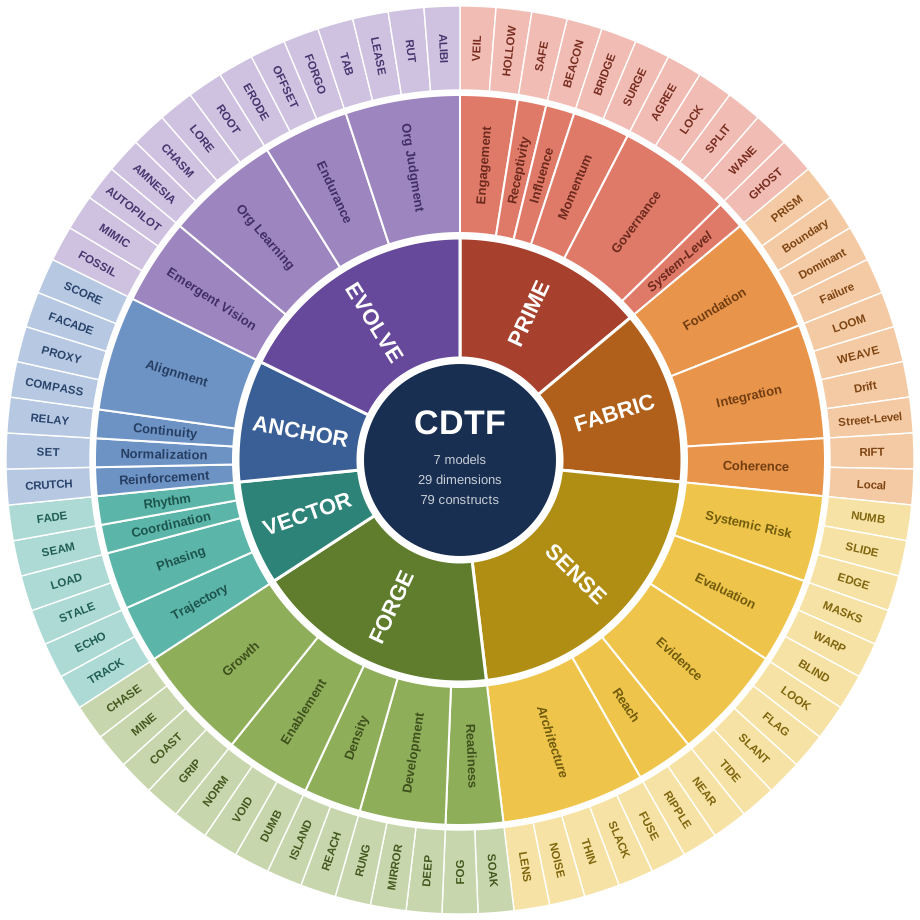
CDTF uses seven connected models. They are not phases and they are not a checklist. Their relative importance shifts as conditions change. For the 30 percent productivity estimate, the framework would treat the number as a hypothesis, not a 30 percent workforce answer. The question becomes what the organization needs to learn before it commits to a staffing outcome.
SENSE: Are AI productivity gains being mistaken for evidence that fewer people are needed?
SENSE would start with the evidence. Meta shows why. If management tracks code produced, transactions automated, calls handled, prompts entered, or hours theoretically saved, the organization can accumulate impressive numbers without knowing whether value improved. SENSE pushes the investigation toward the broader condition. What happened to quality? Reliability? Customer outcomes? Revenue? Risk? Rework? Tasks or responsibilities that moved somewhere else? What are employees doing informally to compensate for weaknesses in the new process? The point is to find out what changed in the system, not simply whether the automation target was hit.
That also changes how risk is handled. Block's filing describes several risks before the reduced operating model has fully proved itself: lost expertise, heavier workloads, errors, weaker innovation, service disruption, and control failures. Those are risks while they are possibilities. If workloads actually become unmanageable or error rates rise, the job changes. The organization now has an issue that needs diagnosis and a response. CDTF keeps the same evidence connected to design and execution, so management is not left with a risk register that says the event happened while the workforce plan continues untouched.
PRIME: Will employees surface automation opportunities honestly if those discoveries could eliminate jobs?
PRIME and FABRIC bring in conditions that are easy to miss when the discussion is dominated by productivity. Employees know when an automation program may affect their jobs. That changes what some people are willing to say about the technology. If management wants employees to identify tasks that can be automated while those employees believe doing so may eliminate their own roles, the organization has created a problem in the information it is trying to collect. PRIME asks whether people can raise concerns, limitations, and uncomfortable evidence honestly.
FABRIC: Do Finance, HR, Technology, and Operations mean the same thing when they say AI has created ‘capacity’?
FABRIC asks whether Finance, HR, Technology, Operations, and the affected functions are even using the same meaning of productivity, value, capability, and success. They often are not. One group can see a cost reduction while another sees lost expertise, transferred workload, or a control that no longer has an owner.
FORGE: What capability are you removing along with the tasks AI can now perform?
FORGE goes after the capability question directly. An organization can reduce staffing demands and still damage the way expertise is built. If AI takes over the research, analysis, drafting, coding, or routine cases through which less experienced employees learn, the organization needs another way to develop judgment. That risk is easy to miss because nothing fails immediately. The workforce can look more productive for years before management realizes that the pipeline of experienced people has weakened. FORGE asks whether the future organization can actually perform under real conditions, not whether people completed training or learned to use the tool.
VECTOR: After AI removes tasks from a role, where do the remaining responsibilities, judgment, and accountability actually go?
VECTOR looks at what happens across the system when one part of the workforce changes. Removing tasks from one function can move exceptions, approvals, customer problems, compliance decisions, or troubleshooting somewhere else. A headcount reduction can therefore succeed locally while creating additional demand in another part of the organization. VECTOR makes those dependencies visible and keeps sequencing tied to readiness. If an automated process still depends on heavy manual review, reducing the review capacity first is not efficiency. It is a sequencing problem that has been converted into an operating issue.
ANCHOR: Will the leaner operating model still work once the extra oversight, experts, and implementation support disappear?
ANCHOR asks a different question that becomes important after the early results look good. AI transformations often receive unusual support during rollout. Experienced employees check outputs. Central teams solve problems quickly. Managers pay close attention. Vendors or outside specialists may still be involved. Some early productivity gains are therefore being produced inside a supported environment that will not exist forever. ANCHOR asks whether the new way of operating still works when that scaffolding is removed. A permanent workforce decision should not be based on performance that only exists while temporary support is carrying part of the load.
EVOLVE: Can new evidence still change the headcount target once the savings are already built into the plan?
EVOLVE keeps the future state from becoming untouchable. This is where the organization has to be willing to admit that the evidence changed. A workforce plan may start with a reasonable assumption and become less reasonable six months later. New responsibilities may appear. Customer expectations may change. AI may improve faster than expected or create problems nobody anticipated. EVOLVE treats that learning as something that should change current decisions, not as an interesting lesson to document after the restructuring is finished.
This is also where the organization has to think about options it may be giving up too early. Expertise can leave. Development paths can disappear. Customer knowledge can be lost with the people who carried it. Informal coordination that never appeared on an organization chart can vanish when roles are removed. Some of those losses may be acceptable. The organization should know what it is giving up before the decision becomes difficult to reverse.
Reversibility matters because workforce choices preserve different amounts of room to change course. Slower hiring, attrition, redeployment, and reskilling generally leave more options open than removing large numbers of experienced employees. Klarna's earlier reliance on attrition made it easier to resume hiring when its priorities shifted. Wipro's redeployment kept people and institutional knowledge inside the company. A large reduction like Block's is harder to reverse because expertise, relationships, and informal coordination may leave before the operating model is fully proved. None of these mechanisms is automatically right or wrong. Under uncertainty, the cost of discovering that the original assumption was wrong should be part of the decision.
The same logic applies to Walmart, Wipro, and IKEA. Their approaches preserved more room for learning, but the choices themselves are not the framework. CDTF would still ask whether Walmart is developing the judgment and capability needed for the jobs that remain, whether Wipro's redeployment is moving people into roles where their knowledge can actually create value, and whether IKEA's new customer-facing roles continue to make economic sense as the technology changes. A good decision at one point in a transformation can become a bad decision later if the conditions around it change and nobody reopens the diagnosis.
The business case still has a role. It should estimate productivity, model workforce scenarios, and put real numbers around the economic opportunity. The mistake is allowing one scenario to become the destination before the transformation has generated enough evidence to support it. Avoiding headcount lock-in does not mean refusing to reduce headcount. It means keeping the workforce decision open long enough for evidence to separate plausible scenarios.
A better way to handle the original 30 percent productivity estimate is to treat it as the beginning of the investigation. Measure which tasks actually disappear. Measure what happens to quality, reliability, customer outcomes, revenue, risk, employee judgment, workload, and the responsibilities that remain. Track where responsibilities move. Watch what new activities become possible because AI made them cheaper or easier. Test whether the new operating model still performs when temporary support is removed. The evidence may support a smaller organization. It may support reductions in one area and growth somewhere else, or a very different organization with roughly the same number of people.
AI can change the economics of labor very quickly. The future organization does not become obvious at the same speed. The uncertainty stays. CDTF gives the organization a disciplined way to keep learning from it instead of treating it as already resolved.
Sources and Notes
- Reuters. Mark Zuckerberg had a bold plan to replace Meta staff with AI. Here's how it imploded. August 26, 2026. Accessed September 19, 2026
- Reuters. Sweden's Klarna says AI chatbots help shrink headcount. August 27, 2024. Accessed September 19, 2026
- Reuters. Sweden's Klarna shifts AI focus from cost cuts to growth. September 10, 2025. Accessed September 19, 2026
- U.S. Securities and Exchange Commission. Comment letter to Klarna Group plc. May 30, 2025. Accessed September 19, 2026
- Reuters. Jack Dorsey's Block to cut nearly half its workforce in AI overhaul, shares surge. February 26, 2026. Accessed September 19, 2026
- Block, Inc.. Form 10-K for fiscal 2025. 2026. Accessed September 19, 2026
- McKinsey & Company. AI job losses fall short of forecasts. September 3, 2026. Accessed September 19, 2026
- Walmart. 2026 Jobs Spotlight Report. July 16, 2026. Accessed September 19, 2026
- Walmart. Walmart Unveils New AI-Powered Tools To Empower 1.5 Million Associates. June 24, 2025. Accessed September 19, 2026
- Reuters. Wipro's AI push frees capacity equivalent to 20,000 workers, CTO says. September 10, 2026. Accessed September 19, 2026
- Ingka Group. Annual & Sustainability Summary Report FY18. 2018. Accessed September 19, 2026
- Ingka Group. A small group of managers taking decisions in a centralized way no longer works. 2022. Accessed September 19, 2026
- Ingka Group. AI and Remote Selling bring IKEA design expertise to the many. June 29, 2023. Accessed September 19, 2026
- Fortune. Inside Ikea's big bet on humans in the age of AI. July 30, 2026. Accessed September 19, 2026
- TheCDTF.com. Capability-Driven Transformation Framework overview. Accessed September 19, 2026
- TheCDTF.com. Why Well-Managed Transformations Fall Short: Introducing the Capability-Driven Transformation Framework. Accessed September 19, 2026